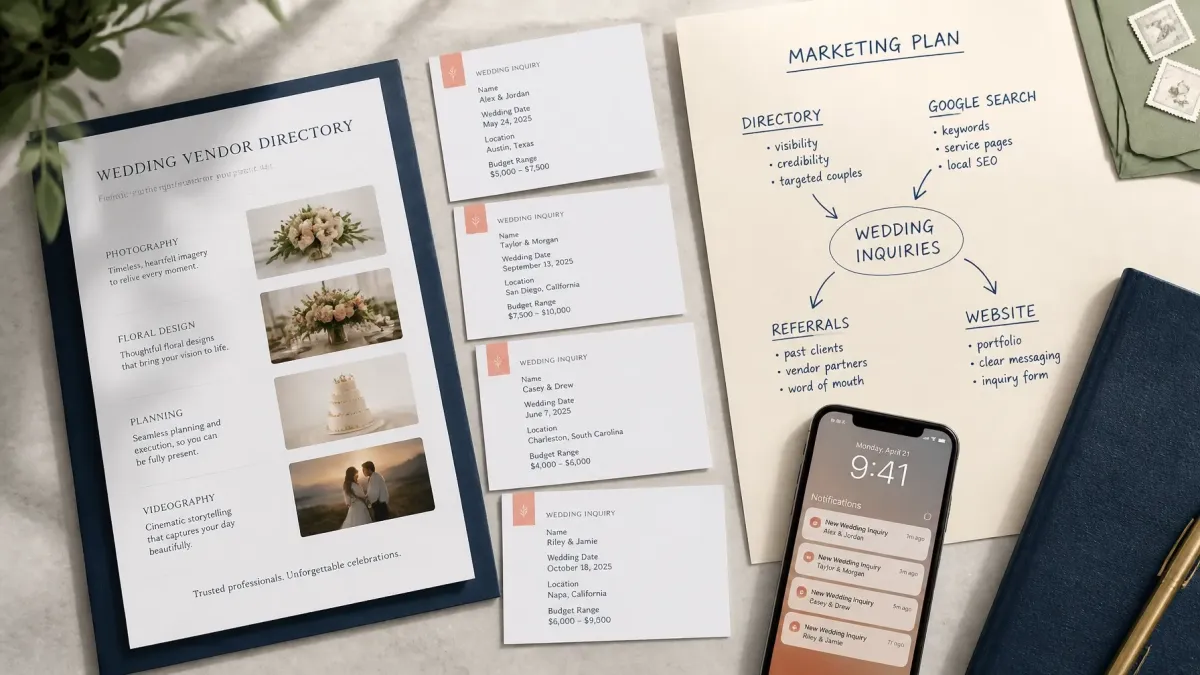
Are Directory Leads Dead? Why Top Wedding Pros Are Switching to Automated Lead Generation
Wedding directories can still support visibility and credibility, but they should not be the only source of bookings. Here is how planners, photographers, florists, venues, DJs, and other wedding professionals can build a more reliable lead-generation system.
A directory profile can put your business in front of couples who are actively searching. But if you have invested in a listing and seen fewer qualified inquiries, more price shoppers, or little connection between leads and bookings, you are not alone.
The question is not whether wedding directories are completely dead.
The better question is whether they are still reliable enough to carry your entire marketing strategy.
For many wedding vendors, the answer is no. Directories can still play a useful role, but the strongest businesses are building a diversified system that combines search, referrals, social media, owned lead capture, and consistent follow-up.
That shift creates more clarity for vendors and couples alike.
Why Directory Leads Feel Less Reliable
Wedding directories offer convenience. Couples can compare vendors, browse photos, read reviews, and send inquiries from one place.
That convenience is valuable. It is also part of the challenge.
A single couple may contact several photographers, florists, planners, or venues through the same platform. Your inquiry may be competing with five or ten others before you ever have a chance to start a conversation.
Some directory leads are also early in the planning process. They may be gathering ideas, comparing prices, or sending the same general message to multiple businesses.
That does not make the lead worthless. It simply means the vendor has less control over the relationship.
Common frustrations include:
Shared inquiries that create immediate competition
Leads with limited event details or unclear buying intent
Rising listing or advertising costs
Difficulty tracking which inquiries become bookings
Couples who never respond after the initial message
Heavy dependence on a platform you do not own
From the couple’s perspective, directories make research easier. From the vendor’s perspective, they can make differentiation and attribution harder.
Both experiences are valid.
Directory Leads Are Not Dead: but They Should Not Stand Alone
A directory can still help your business in several ways.
A complete profile gives couples another place to confirm your services, style, location, reviews, and experience. It may also support brand visibility when someone discovers you elsewhere and searches for additional information.
Directories can be especially helpful when:
Your profile has current, high-quality images
Your reviews are recent and detailed
Your service area is clearly explained
Your starting prices or pricing range are easy to understand
Your description speaks to a specific type of couple or event
You can track traffic and inquiries from the listing
The best approach is to treat directory listings as one part of your marketing mix: not as your only lead engine.
Your goal should be to create multiple paths for couples to find and contact you, while bringing as many of those conversations as possible into a system you can manage.
Build a More Diverse Lead-Generation Strategy
A reliable wedding business does not depend on one platform, one referral partner, or one type of advertising.
Diversification helps protect your business when a directory changes its pricing, algorithm, lead quality, or terms.
Consider building a mix that includes the following channels.
1. Search and local visibility
Couples often begin with searches such as:
Wedding photographer near me
Garden wedding venue in [city]
Luxury wedding florist in [region]
Month-of wedding coordinator
Affordable wedding DJ for 150 guests
Your website and Google Business Profile should make it easy for people to understand what you offer and where you work.
Helpful strategies include:
Creating service pages for your main offerings
Listing the cities or regions you serve
Publishing useful planning content
Showing real weddings and client experiences
Keeping your contact details consistent across platforms
Asking happy clients for detailed reviews
Search traffic can take time to build, but it gives you a channel you have more control over than a shared directory inbox.
2. Vendor referrals
Referrals remain one of the most valuable sources of wedding business because trust is already part of the introduction.
A planner may recommend a photographer. A venue may refer a florist. A DJ may suggest a coordinator they know will communicate well.
Strong referral relationships are built through reliability, not just networking.
Best practices include:
Following through consistently
Sharing clear information about your ideal clients
Referring business when the fit is right
Creating preferred-vendor guides
Collaborating on styled shoots or educational content
Staying in touch after the wedding season ends
A referral does not guarantee a booking, but it often gives you a warmer starting point than an anonymous inquiry.

3. Social media and content
Instagram and other social platforms can help couples understand your personality, process, and style before they contact you.
The goal is not to post constantly. The goal is to make your content useful and recognizable.
Show:
Recent work
Behind-the-scenes moments
Client testimonials
Frequently asked questions
Your service areas
Your planning or booking process
Examples of how you solve common wedding-day problems
Every profile should also lead somewhere useful. Instead of making a couple search for your contact information, direct them to a focused inquiry page or consultation option.
Own the Inquiry Once Someone Reaches You
No matter where a lead comes from, the inquiry process is where you begin building trust.
A directory may introduce the couple to your business, but your response determines what happens next.
A short, focused form is often easier to complete than a long questionnaire. Start by collecting the details you need to begin a conversation:
Name
Email address or phone number
Wedding date or approximate timeframe
Venue or location, if known
Service requested
You can gather additional information during the consultation.
The first step should feel simple, clear, and welcoming. Couples should know what happens after they submit the form and when they can expect to hear from you.
Speed Matters: Especially When Couples Are Comparing Vendors
Wedding inquiries often arrive while you are photographing an event, setting up flowers, coordinating a rehearsal, serving clients, or driving between venues.
You cannot always respond personally within minutes.
That is a practical reality: not a sign that you do not care.
The problem is that couples may not know what is happening on your side. If they receive no acknowledgment, they may assume you are unavailable and contact someone else.
An immediate, helpful response can bridge that gap.
It can:
Confirm that the inquiry was received
Set expectations for a personal reply
Share basic next steps
Answer a common question
Offer a consultation link
Invite the couple to reply with their date or venue
The message should sound like your business, not like a generic robot. Automation should support your service, not replace your voice.
See how Bridal Boomerang helps wedding vendors respond to new inquiries instantly.

Follow-Up Turns Interest Into a Conversation
Many inquiries do not convert after one message.
A couple may be busy, waiting on a venue decision, comparing dates, or unsure what to ask next. A quiet inbox does not always mean a definite no.
A thoughtful follow-up sequence gives interested couples more opportunities to engage without requiring you to remember every reminder manually.
A practical sequence might look like this:
Immediately
Confirm the inquiry and provide a clear next step.
Within one business day
Send a personal reply that references their event details. Mention the date, venue, style, guest count, or service they asked about.
Two or three days later
Answer a common question or share a helpful resource. This could be a pricing guide, planning checklist, gallery, or overview of your process.
About a week later
Send a friendly check-in and invite them to schedule a call, tour, tasting, or consultation.
Later, when appropriate
Continue occasional nurture with useful content, availability updates, or real wedding examples.
Follow-up should be respectful and relevant. The purpose is not to pressure couples into booking. It is to make it easier for them to make an informed decision.
Track What Actually Produces Bookings
Lead volume can be misleading.
A directory may send many inquiries, but another channel may generate fewer leads with a much higher booking rate. To understand what is working, track the full journey:
Where the inquiry came from
Whether the lead was qualified
How quickly you responded
Whether a consultation was scheduled
Whether a proposal was sent
Whether the lead booked
Revenue generated by the source
Use tagged links where possible, and review your results monthly or quarterly.
Your marketing budget should follow evidence: not habit.
If a directory produces strong visibility but few bookings, you may decide to keep a basic listing for credibility while investing more heavily in search, referrals, content, or owned lead capture.
The More Sustainable Path Forward
Directory leads are not necessarily dead. But relying on them as your primary source of business can leave your bookings vulnerable and your marketing difficult to measure.
A stronger strategy combines:
Multiple discovery channels
A clear website and inquiry process
Short, focused forms
Fast acknowledgment
Helpful automated follow-up
Personal conversations at the right time
Consistent tracking and review
This approach benefits everyone.
Couples receive clearer information and faster communication. Vendors spend less time chasing unanswered messages and more time serving clients. Business owners gain better visibility into what is actually driving growth.
The goal is not to eliminate directories.
It is to make sure your business can continue generating and converting inquiries even when one platform slows down.
